

Responsible Business
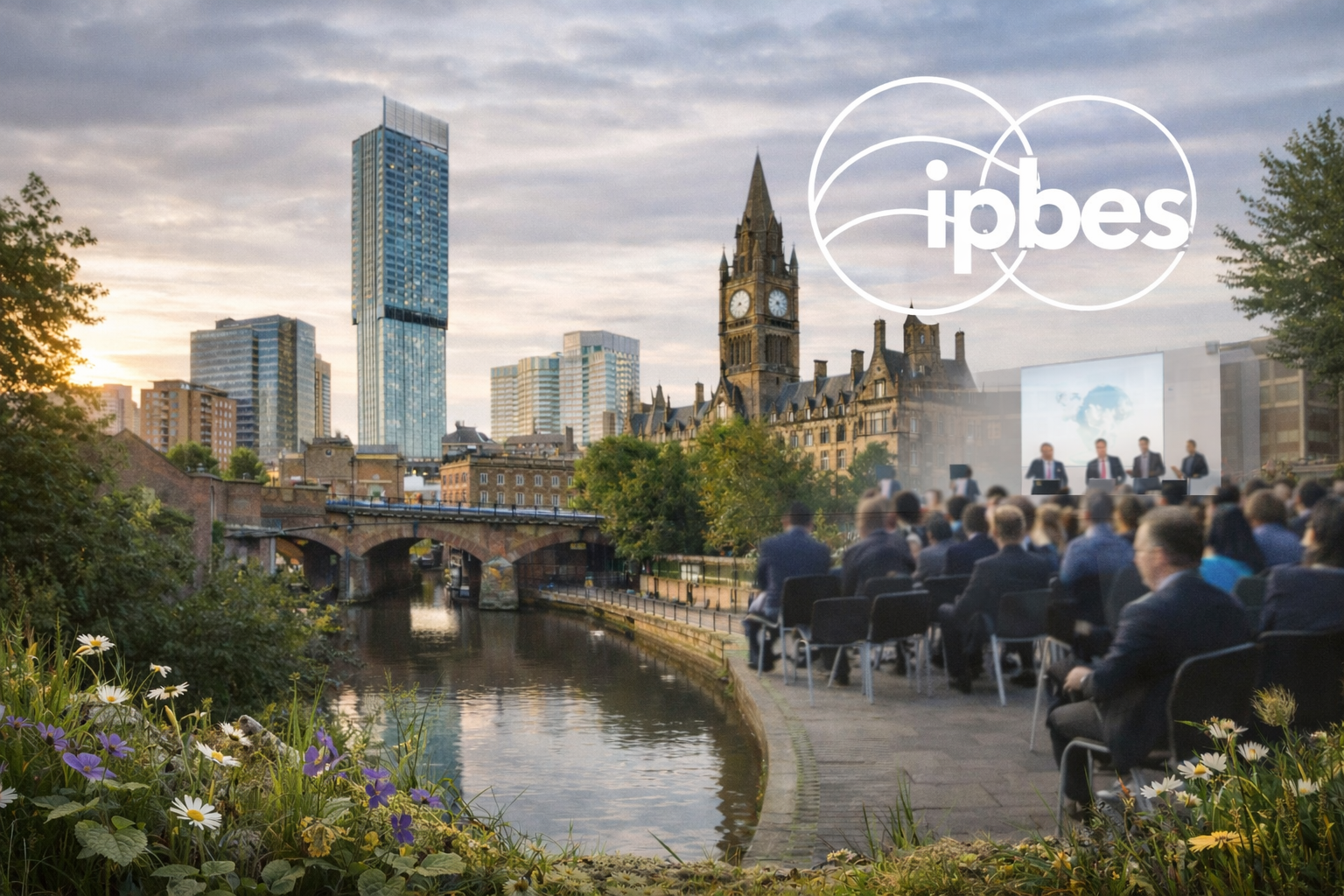
This week Manchester is the beating heart of global biodiversity science-policy, and business has a front-row seat
For the first time in its history, the Intergovernmental Science‑Policy Platform on Biodiversity and Ecosystem Services (IPBES) has convened its plenary in the UK. From 3 to 8 February, governments, scientists, Indigenous knowledge holders, NGOs, investors and corporate sustainability leaders have gathered in Manchester for IPBES-12.
At the centre of this moment is a major new scientific assessment expected to be formally adopted and released during the plenary: the IPBES Business and Biodiversity Assessment. It is the first global assessment to systematically examine how business depends on and impacts biodiversity, and how evidence-based approaches can help transform corporate practice at scale.
Its publication is likely to be one of the most influential biodiversity science products of the decade. This assessment does not treat nature as an externality or an abstract moral concern. It examines how living systems underpin prosperity, risk, resilience and long-term economic performance.
Three years in the making, the assessment draws on global peer-reviewed science and integrated perspectives from Indigenous peoples and local communities, alongside insights from business, finance and environmental experts. Its central finding is stark: biodiversity loss is both a systemic business risk and a strategic inflection point. Companies can either continue to erode the systems they rely on or redirect capital, governance and decision-making towards recovery.
Why this week matters
IPBES exists to bridge rigorous science and real-world decision-making. Its assessments are widely regarded as the authoritative evidence base for governments and multilateral policy. Increasingly, they also shape expectations of business and finance.
In Manchester this week, member governments are negotiating the approval of the Business and Biodiversity Assessment, the first global synthesis of how business activities interact with nature and how those interactions can be measured, managed and changed.
“This IPBES Business and Biodiversity Assessment makes a vital contribution to exposing and explaining how business, economies and development are entwined with nature’s health and resilience,” said Alexander De Croo , Administrator of the United Nations Development Programme.
That framing matters. Previous IPBES assessments have already reshaped global understanding of nature loss. The 2019 Global Assessment warned that one million species face extinction and identified economic activity as a primary driver. The 2023 Invasive Alien Species Assessment showed how poorly managed systems amplify ecological and economic damage. The Business and Biodiversity Assessment takes the next logical step: it speaks directly to boardrooms.
Science into practice at Alliance Manchester Business School
On the evening of 2 February, Alliance Manchester Business School and the Royal Society for the Protection of Birds RSPB hosted Business Impact: Driving biodiversity recovery through business action. The aim was practical rather than rhetorical: translating the evidence emerging from IPBES into decisions businesses can actually make.
One message cut through with clarity. Biodiversity has moved from values to value.
Speaker after speaker returned to the same truth. Nature underpins business performance. Its decline creates material risk across supply chains, infrastructure, finance and communities.
Andrea Ledward CBE , International Biodiversity and Climate Director at the UK Department for Environment, Food and Rural Affairs, was explicit about the direction of travel. Biodiversity expectations are now policy-driven, internationally coordinated and increasingly specific about what is required of business. The UK’s role in hosting IPBES-12 was presented as a signal of intent rather than diplomatic ceremony.
The science is ready. Business needs to catch up.
The most consequential contribution came from Katie Leach, PhD , Head of Nature at Lloyds Banking Group and a Coordinating Lead Author on the Business and Biodiversity Assessment.
Her message was direct. The science now clearly maps how business both depends on and drives biodiversity loss. The assessment moves beyond abstract ecosystem services into language boards recognise: dependencies, impacts, risks and leverage points. For financial institutions in particular, uncertainty can no longer be used as a justification for delay. The evidence base exists. Uptake remains inconsistent.
This was framed as opportunity rather than accusation. The same financial and operational systems that have accelerated degradation can, if redirected, support recovery at scale.
From disclosure to decisions
A recurring frustration across the panel was performative action. Biodiversity disclosures, targets and commitments have multiplied. Meanwhile, ecological decline continues.
Tom Burditt , Chief Executive of The Wildlife Trusts in the North West, spoke candidly about the gap between ambition and outcomes. Recovery requires long-term thinking, place-based investment and patience. These do not sit comfortably with short reporting cycles or siloed sustainability teams.
The conversation repeatedly returned to governance. Biodiversity cannot live solely within ESG or environmental functions. It must be owned at board level, embedded in risk frameworks and reflected in capital allocation. That shift, panellists noted, remains uneven.
Collaboration is unavoidable
The panel itself reflected the nature of the challenge. Finance, government, civil society and academia shared the stage, not in polite consensus but in productive tension.
Jo Harrison of United Utilities described the realities of operating essential infrastructure in a degraded environment. Flooding, water quality and system resilience are already shaped by nature loss. Collaboration with regulators, communities and conservation organisations is no longer optional.
Javed Siddiqui and Edward Pollard reinforced the same point from different angles. The science may be global. Solutions are local, relational and context-specific.
What Manchester symbolised
There was something quietly powerful about hosting this conversation in Manchester rather than a capital more commonly associated with environmental diplomacy. The city understands industrial growth and externalised costs. This week, it is hosting a reckoning with those same forces, reframed through biodiversity.
IPBES-12 is not only about agreeing text in a plenary hall. It is about whether business is prepared to absorb what the science is now saying and act accordingly.
The uncomfortable truth surfaced repeatedly. Biodiversity loss is already embedded in business models. The counterpoint is equally clear. With the evidence now available, inaction has become a choice rather than an excuse.
As IPBES-12 continues this week, boardrooms would do well to pay attention. The conversation has shifted. The question is whether business will move with it.
READY TO BE A RESPONSIBLE BUSINESS?
Contact us today to learn more about how we can help you take meaningful steps toward a sustainable, purpose-driven future.