

Responsible Business Insights
National Security Assessment: Global biodiversity loss, ecosystem collapse and national security. Responsible Business review and position statement.
The UK Government has published the Nature security assessment on global biodiversity loss, ecosystem collapse and national security. The assessment examines how accelerating biodiversity loss and the degradation or collapse of critical ecosystems could affect the UK’s resilience, security and prosperity.
This page sets out Responsible Business’s position on what boards and executive teams should do next.
Nature risk now sits alongside operational continuity, cost volatility and strategic resilience.
What the Nature security assessment covers
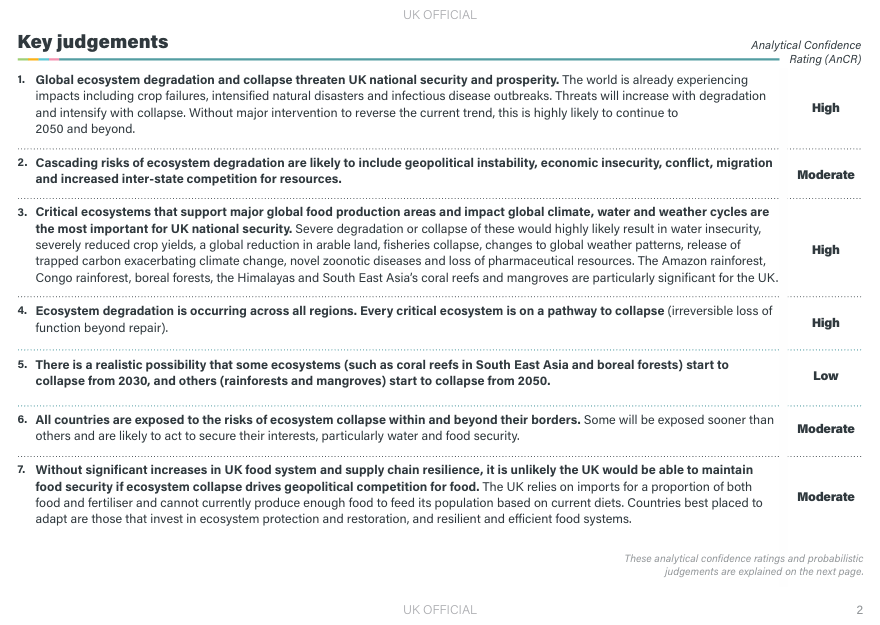
The assessment connects ecosystem decline to risks that travel through the systems the UK relies on, including food, water, health, trade, prices and geopolitical stability. Its lens is national security, so it focuses on cascading impacts and reasonable worst-case dynamics, including uncertainty.
Several parts of the assessment are particularly relevant for business.
It emphasises global exposure. UK organisations depend on supply chains that run through places where nature is under stress and where ecosystem disruption can trigger shocks.
It highlights strategic ecosystems whose degradation can generate wider consequences that reach the UK through markets, logistics and political stability.
It also reinforces a point that boards tend to underestimate: nature-related disruption rarely arrives as a single clean incident. It shows up as a chain of compounding effects that spread across functions.
Responsible Business position
Responsible Business supports the assessment’s central conclusion. Nature loss creates material security risks. Those risks translate into business risks.
Boards have a duty to understand and manage the dependencies that keep their organisations functioning. Ecosystems are part of that dependency base. When ecosystem services weaken, organisations experience pressure through procurement, pricing, availability, quality, insurability and social stability. The effect is often gradual, then sharp.
This position draws on evidence that sits well beyond one publication.
The United Kingdom Food Security Report 2024 describes climate change, biodiversity loss and water insecurity as pressing risks to food security. It also links long-term decline in natural capital to risks for domestic food production and resilience.
The Office for National Statistics estimates the asset value of UK ecosystem services at around £1.8 trillion in 2022. That figure signals that nature functions are economically material.
The Dasgupta Review, commissioned by HM Treasury, argues that economies are embedded within nature and that decision-making should account for nature as an asset base that requires maintenance and investment.
The global assessment led by the Intergovernmental Science-Policy Platform on Biodiversity and Ecosystem Services concludes that around one million species are threatened with extinction and sets out the human-driven pressures behind biodiversity loss, alongside the need for systemic change.
The World Health Organization links ecosystem disruption and biodiversity change to shifts in disease dynamics and infectious disease risk.
Taken together, the direction is consistent. The UK Government assessment provides a security lens. The wider evidence base supports the same conclusion.
What this means for boards and risk registers
Many organisations already mention biodiversity and nature in strategy documents. The gap appears later, in governance and in how investment decisions get made.
Nature-related dependencies and risks need a formal place within enterprise risk management. That includes ownership, controls and board visibility. Without those elements, nature risk stays as a narrative that never converts into resilience.
A well-managed approach has a few clear features.
It identifies the business-critical dependencies on ecosystem services across operations and supply chains. That includes water availability, soil health, flood regulation, coastal protection and disease regulation.
It maps exposure across priority commodities and geographies, including where suppliers rely on ecosystems under pressure.
It links those exposures to operational and financial outcomes, including volatility, lead times, quality disruption and contractual risk.
It assigns executive ownership with authority and budget responsibility.
It reports progress through a repeatable cadence so the board receives early signals rather than post-event explanations.
These steps reduce fragility. They also make decisions easier to defend when trade-offs appear.
Why the national security framing matters commercially
Security assessments tend to focus on systemic exposure and cascading impact.
That focus is useful for business because it aligns with how real disruption behaves. Ecosystem decline drives pressures that can amplify each other. Food price volatility can combine with water stress. Flood events can combine with constrained insurance appetite. Disease dynamics can combine with labour disruption. Supply chain shocks can combine with political instability.
Boards already manage compounding risks in other domains. Nature now belongs on that list.
Nature disclosure and decision-grade governance
Investors, lenders and insurers increasingly expect coherent, evidence-led narratives about nature-related risk and resilience. That expectation is starting to influence capital allocation and underwriting.
The Taskforce on Nature-related Financial Disclosures provides recommendations designed to help organisations identify, assess and manage nature-related dependencies, impacts, risks and opportunities. Many organisations treat this as a reporting exercise. It can also act as a governance discipline because it forces clarity on where dependencies sit, how risk is managed and what is measured.
Responsible Business encourages clients to use the structure to improve management decisions, board oversight and strategic resilience.
Global policy direction and why expectations will tighten
The Kunming–Montreal Global Biodiversity Framework sets global goals and targets for 2030 and calls for urgent action across society. That direction will keep flowing into procurement standards, due diligence expectations, customer requirements and financing conditions.
Organisations that prepare early gain room to move. Late movers face tighter constraints and higher costs.
What Responsible Business supports clients to do
Responsible Business works with organisations that want to respond in practical terms. This often includes:
Nature dependency and impact mapping across operations and supply chains
Integration of nature-related risks into enterprise risk management with clear owners, controls and early-warning indicators
Scenario testing and stress-testing for plausible disruption pathways
Board reporting packs that translate nature risk into operational and financial language
Evidence-led reporting support aligned with established disclosure recommendations
The aim is straightforward. Build resilience. Protect continuity. Improve decision-making quality. Deliver measurable outcomes.
Frequently asked questions
What is the Nature security assessment on global biodiversity loss, ecosystem collapse and national security?
It is a UK Government national security assessment exploring how global biodiversity loss and ecosystem degradation could affect UK resilience, security and prosperity.
Who published the Nature security assessment on global biodiversity loss, ecosystem collapse and national security?
The publication is issued by the UK Government and hosted on GOV.UK under the same title.
Why does the assessment matter for business?
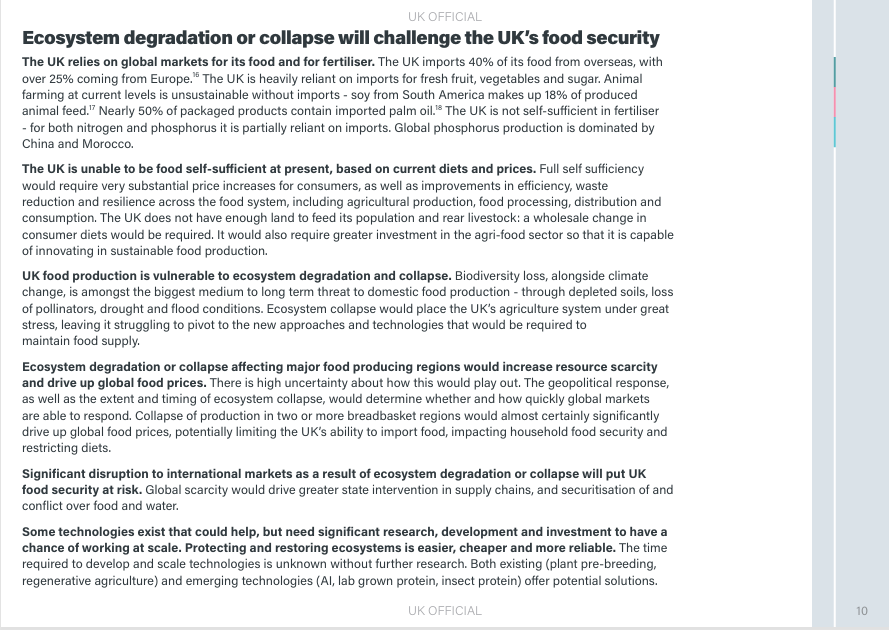
The assessment links ecosystem decline to disruptions that can affect supply chains, commodity prices, availability of key inputs, health risks and wider stability. These factors influence operational continuity and strategic resilience.
What should boards do in response?
Boards should treat nature-related dependencies as business-critical, assign clear ownership, include nature risk in enterprise risk management, stress-test exposure across supply chains, and track meaningful indicators over time.
How does this relate to food security and supply chain risk?
UK Government food security reporting links biodiversity, healthy soils and clean water to food productivity and resilience. Disruption in nature systems can drive volatility that flows through procurement, pricing and delivery.


READY TO BE A RESPONSIBLE BUSINESS?
Contact us today to learn more about how we can help you take meaningful steps toward a sustainable, purpose-driven future.